
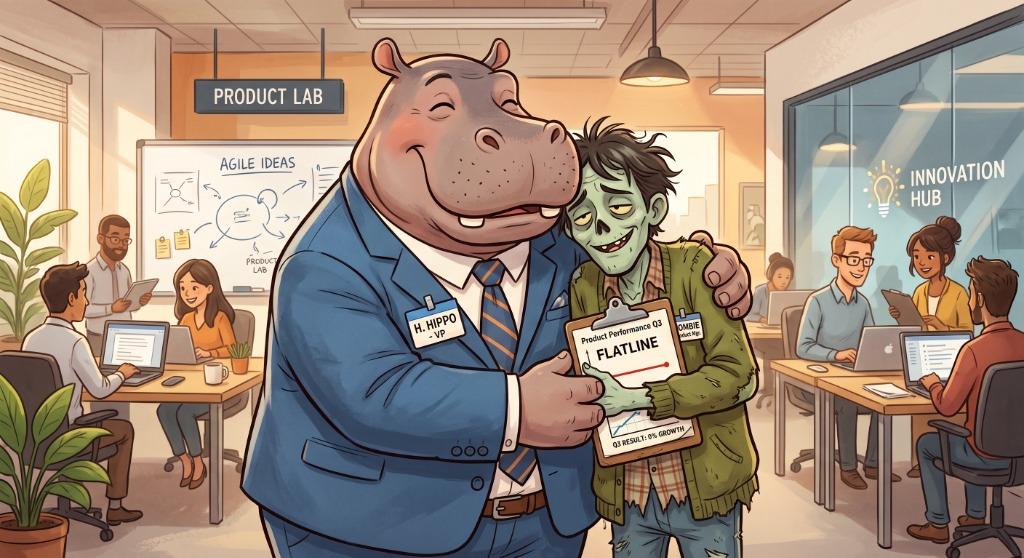
Every mature tech organization has a ghost ship staffed by two dozen of its best engineers.
Walk past the agile whiteboards and the glass-walled innovation hubs, and you will spot a peculiar pair. On one side is an initiative whose organic customer adoption is flat. Retention numbers only stabilize when sales quietly bundles the capability into enterprise contracts for free. The user problem it was designed to address has proven far more elusive than anticipated. Yet it continues to receive dedicated engineering pods, quarterly roadmap real estate, and ongoing support attention.
On the other side is the executive with an arm warmly draped around its shoulder.
This is a Product Zombie: an initiative that has stalled in market traction, yet continues to glide through sprint cycles on organizational momentum.
When retrospectives explore why these initiatives persist, people point to technical inertia, complex contracts, or the sunk cost fallacy. While those forces certainly play a role, one of the most powerful and overlooked catalysts is structural: product zombies thrive inside the protective shelter of the HiPPO (Highest Paid Person's Opinion).
This relationship is not adversarial or careless. In fact, it is remarkably comfortable and well-intentioned. Product zombies do not survive in spite of executive leadership alone. Among all the reasons a project lingers, an executive champion provides the unique air cover that neutralizes standard market scrutiny, creating an affection trap that neither side knows how to escape.
Part 1: How Visionary Conviction Unintentionally Creates a Zombie
Top product executives and founders are hired to see around corners. They are responsible for placing the big, non-consensus bets that incremental customer surveys and sprint-level data cannot predict. That foresight is vital to long-term survival.
However, the very strength of executive conviction introduces a unique organizational challenge:
1. The Weight of High-Conviction Bets
When a junior product manager suggests a new feature, the organization defaults to skepticism. The idea must pass through user discovery, competitive audits, and prototype tests before receiving investment.
When a senior executive or founder identifies a strategic opportunity, the dynamic flips. Because leadership carries a wider market perspective, relationships with the board, and deep industry pattern recognition, the organization assumes the validation has already occurred. Teams naturally skip asking "Does the market want this problem solved this way?" and move straight to "How quickly can we execute leadership's vision?"
2. The Multi-Product Imperative
Senior leaders are constantly thinking about the company's next horizon. They know that single-product companies eventually plateau, so they proactively champion secondary platforms, new business lines, or ecosystem plays.
Once an executive presents this vision to the board or at a company all-hands as the next strategic chapter, the initiative becomes a corporate priority. The intent is entirely sound: to rally the company around future growth. But that high-visibility backing gives the initiative an institutional momentum that ordinary features never receive.
3. The Natural Filtering of Feedback
Hierarchies naturally filter uncomfortable news as it travels upward. As user feedback and early adoption signals move through customer support, sales conversations, and product analytics, the rough edges get smoothed out.
Qualitative hesitation from customers is summarized as "early feedback." Low daily usage is framed as "enterprise accounts still completing onboarding." Because teams respect their leaders and want their strategic bets to succeed, they unconsciously present data in the most hopeful light possible, keeping the executive smiling while the product flatlines on the ground.
The initiative has officially become a zombie, not because leadership is disconnected, but because the organization is working overtime to make a visionary bet come true.
Part 2: Why Stagnant Bets Find Safety in the HiPPO's Shadow
Once an executive-sponsored bet stalls, why does it remain so difficult to address compared to standard platform debt?
The Executive Air Cover
When an ordinary initiative misses its performance milestones, the path is clear: evaluate, iterate, or decommission.
When an initiative carries executive pedigree, the hurdle for decommissioning is vastly higher. Leaders naturally want to give their strategic initiatives enough time and runway to mature. In enterprise software, new categories can take years to catch on. That patience is often a virtue, but in the case of a zombie product, it acts as indefinite air cover, shielding the initiative from the market forces that should guide its evolution.
The Team's Accountability Shield
For the product managers, designers, and engineers assigned to the project, the executive's involvement provides remarkable career safety.
If a product squad champions an autonomous experiment that falls flat, the team feels exposed. But if a team is assigned to a high-profile initiative sponsored by the Chief Product Officer, the career risk is effectively absorbed by the executive's mandate. If customer traction fails to materialize, the team is still recognized for disciplined delivery: "We delivered every milestone in the strategic charter on schedule."
This creates a comfortable equilibrium. High-performing teams stay busy delivering clean code and polished roadmaps, yet the underlying market reception never truly takes root.
The Iteration Trap
Because nobody doubts the strategic importance of the problem space, the team responds to soft metrics by tweaking secondary elements rather than questioning the core bet:
- The Positioning Revision: "The market was confused by our messaging; an updated narrative and customer collateral will clarify our value."
- The Infrastructure Upgrade: "The prototype was not flexible enough; re-architecting the platform for enterprise scale will unlock adoption."
- The Workflow Expansion: "If we layer automated workflows or AI assistants into this interface, it will become an everyday habit."
These efforts are well-executed and intellectually demanding. But re-engineering the container does not solve the fundamental reality that customer demand for the solution is missing. Decorating the periphery cannot compensate for an absent core utility.
Part 3: How Product Teams Can Manoeuvre and Partner Upward
Challenging a stagnant initiative that was championed by a respected executive requires tact, empathy, and commercial clarity. Senior leaders do not want to be told their ideas are flawed; they want help making the best decisions for the company's overall health.
Here is how product leaders and managers can navigate this relationship constructively:
1. Frame Conversations Around Carrying Cost and Capacity
Avoid subjective arguments about whether the product is good or bad. Speak in the currency executive leaders care about most: strategic focus and resource allocation.
Quantify the real operational footprint: dedicated engineering squads, customer success attention, ongoing security reviews, and cloud infrastructure spend.
Present the trade-off as an immediate gain: "This platform currently accounts for 2% of our active usage, but requires two full squads to maintain. By consolidating this capability, we can immediately redeploy twelve senior engineers onto our core growth engine, which is currently starved for capacity."
You are not criticizing leadership's original vision; you are helping them optimize company resources in light of new information.
2. Reframe Decommissioning as Capitalizing on Learnings
Visionary leaders invest in initiatives to discover new market territory. When an initiative fails to achieve product-market fit, that is not an operational failure; it is validated discovery.
Highlight the positive takeaway: "This initiative proved that our buyers do not want a standalone system. However, the telemetry shows they heavily value these two specific workflows."
Offer a constructive path forward: "If we migrate those two valuable components into our primary platform, we capture the strategic intent of the original bet while removing the overhead of maintaining an independent product."
3. Co-Design Clear Validation Milestones
When a leader suggests another iteration or pivot for a struggling initiative, do not resist. Instead, partner with them to define objective indicators of success:
We are completely aligned on testing this new workflow. To make sure we give you clear signal on its viability, what customer retention or activation benchmarks should we look for over the next 90 days to confirm we are on the right track?
When leaders help set the benchmarks upfront, the evaluation criteria feel collaborative rather than confrontational.
Part 4: How Top Leaders Can Safeguard Their Own Bets
If you are a Founder, VP of Product, or CPO, your conviction is one of the company's greatest assets. The goal is not to stop placing ambitious bets, but to build organizational mechanisms that keep your authority from accidentally stifling reality.
1. Give Explicit Permission to Pressure-Test Assumptions
Recognize the gravitational pull of your own title. When you introduce an idea, explicitly define its status:
I have a strong strategic hypothesis about this space, but treat it as a bet, not a mandate.
Encourage genuine discovery: "My responsibility is to identify high-potential horizons. Your responsibility is to test my assumptions as rigorously and dispassionately as possible. If the data shows the market is not responding, the most valuable thing you can do for the company is tell me early."
2. Establish Pre-Agreed Off-Ramps at Inception
The most objective moment in any product's lifecycle is before development starts. When launching a major strategic initiative, document the decision checkpoints upfront:
- Specify what sustained traction must look like after six or twelve months.
- Agree in advance on what happens if the numbers are not met: "If we do not see genuine, recurring customer engagement at this threshold, we will conduct an orderly consolidation of the assets and redeploy the team."
When that checkpoint arrives, stepping back is not an emotional retreat; it is executing the plan agreed upon from day one.
3. Reward the Curators, Not Just the Creators
In most tech companies, internal prestige is tied almost exclusively to launches. The team that stands up a new platform is celebrated at the company meeting, while teams maintaining or curating existing systems receive little fanfare.
Change the cultural incentive: publicly recognize product managers and engineering leaders who have the discipline and business acumen to wind down an underperforming bet cleanly.
When people see that leadership values portfolio hygiene and capital efficiency just as much as new product launches, the organizational incentive to nurse a zombie product disappears.
4. Conduct an Annual Clean-Slate Portfolio Review
Periodically step back from existing investments and review your portfolio through a zero-based lens:
Knowing everything we now understand about our market, customers, and competitive landscape, would we commit our best engineers to build this product from scratch today?
If the answer is no, it is time to have a mature conversation about transitioning the product, regardless of how promising the initial hypothesis was.
In conclusion
Great companies are built on the courage of leaders who are willing to take risks on unproven ideas. Without strong executive conviction, the most transformative products in our industry would never have made it past the whiteboard.
The danger is not in placing the bet; it is in letting our respect for that bet overshadow customer reality.
Product zombies love HiPPOs not out of cynicism, but because executive affection is one of the rare forces potent enough to counter market gravity when metrics fall short. When thoughtful leaders encourage rigorous pressure-testing, and product teams learn to navigate upward with empathy and commercial discipline, that affection yields something far more durable: a focused, agile organization where every team is working on problems that customers truly care about.